
Pipe Volume Calculator
Pipe Volume Calculator: Formula, Gallons Per Foot, and Reference Charts
Knowing the volume inside a pipe is essential for dozens of real-world applications — calculating how much water a plumbing system holds, determining line fill volume for a gas or oil pipeline, sizing a heating system, flushing a fire suppression loop, or figuring out how long it takes to fill or drain a pipe run. This guide covers the pipe volume formula, provides ready-to-use gallons-per-foot charts for every common pipe size, and explains how to calculate pipe volume in gallons, litres, and cubic feet.
Pipe Volume Formula
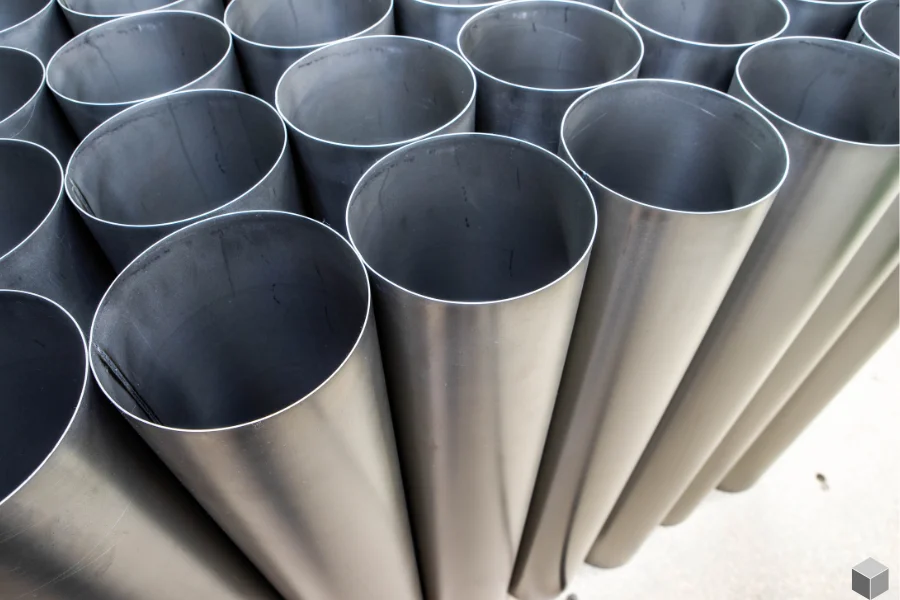
A pipe is geometrically a hollow right cylinder. The formula for the volume of a cylinder is:
Volume = π × radius² × length
For a pipe, use the inner diameter (not the outer diameter) and divide by 2 to get the radius:
Pipe Volume = π × (inner diameter ÷ 2)² × length
Or expressed with diameter directly:
Pipe Volume = (π ÷ 4) × d² × L
Where:
- d = inner diameter of the pipe
- L = length of the pipe
- π ≈ 3.14159
All units must match: if diameter is in inches and length is in feet, convert diameter to feet first (divide by 12), then the result is in cubic feet.
Pipe Volume Formula in Different Units
| Input Units | Output | Formula |
|---|---|---|
| Diameter (inches), Length (feet) | Cubic feet | (π/4) × (d/12)² × L |
| Diameter (inches), Length (feet) | Gallons | (π/4) × (d/12)² × L × 7.48052 |
| Diameter (mm), Length (m) | Litres | (π/4) × (d/1000)² × L × 1000 |
| Diameter (cm), Length (cm) | Cubic cm (mL) | (π/4) × d² × L |
Pipe Volume Calculation: Step-by-Step Example
Example: Calculate the volume of water in 100 feet of 3-inch PVC pipe (inner diameter = 3.068 inches for 3″ Schedule 40).
Step 1 — Convert diameter to feet:
3.068 ÷ 12 = 0.2557 ft
Step 2 — Calculate cross-sectional area:
A = π ÷ 4 × 0.2557² = 0.7854 × 0.06538 = 0.05135 sq ft
Step 3 — Multiply by length:
Volume = 0.05135 × 100 = 5.135 cubic feet
Step 4 — Convert to gallons:
5.135 × 7.48052 = 38.4 gallons
Step 5 — Convert to litres:
5.135 × 28.3168 = 145.4 litres
Our pipe volume calculator performs all five steps instantly — enter inner diameter, pipe length, and your preferred output unit.
Gallons Per Foot of Pipe: Reference Chart
The most common practical need is knowing how many gallons fit in one foot of pipe for a given diameter. Here’s the complete reference for standard pipe sizes:
| Pipe Inner Diameter | Gallons Per Foot | Litres Per Foot | Cubic Feet Per Foot |
|---|---|---|---|
| 1/2 inch | 0.0102 gal/ft | 0.0386 L/ft | 0.001364 ft³/ft |
| 3/4 inch | 0.0230 gal/ft | 0.0871 L/ft | 0.003068 ft³/ft |
| 1 inch | 0.0408 gal/ft | 0.1544 L/ft | 0.005454 ft³/ft |
| 1.25 inch | 0.0638 gal/ft | 0.2415 L/ft | 0.008522 ft³/ft |
| 1.5 inch | 0.0918 gal/ft | 0.3474 L/ft | 0.012272 ft³/ft |
| 2 inch | 0.1632 gal/ft | 0.6175 L/ft | 0.021817 ft³/ft |
| 3 inch | 0.3672 gal/ft | 1.3892 L/ft | 0.049087 ft³/ft |
| 4 inch | 0.6528 gal/ft | 2.4698 L/ft | 0.087266 ft³/ft |
| 6 inch | 1.4688 gal/ft | 5.5572 L/ft | 0.196350 ft³/ft |
| 8 inch | 2.6112 gal/ft | 9.8796 L/ft | 0.349066 ft³/ft |
| 10 inch | 4.0800 gal/ft | 15.437 L/ft | 0.545415 ft³/ft |
| 12 inch | 5.8752 gal/ft | 22.229 L/ft | 0.785398 ft³/ft |
Based on nominal inner diameter. Actual inner diameter varies by schedule (wall thickness) — always use the actual inner diameter for precision calculations.
Volume of Water in a Pipe: Common Pipe Lengths
Using the gallons-per-foot values above, here’s the total water volume for common pipe lengths:
Volume of Water in 2-Inch Pipe by Length
| Length | Cubic Feet | Gallons | Litres |
|---|---|---|---|
| 10 ft | 0.218 | 1.63 | 6.18 |
| 50 ft | 1.09 | 8.16 | 30.9 |
| 100 ft | 2.18 | 16.3 | 61.7 |
| 500 ft | 10.9 | 81.6 | 308.8 |
Volume of 4-Inch PVC Pipe by Length
| Length | Cubic Feet | Gallons | Litres |
|---|---|---|---|
| 10 ft | 0.873 | 6.53 | 24.7 |
| 50 ft | 4.36 | 32.6 | 123.5 |
| 100 ft | 8.73 | 65.3 | 247.0 |
| 500 ft | 43.6 | 326.3 | 1,234.8 |
Volume of 6-Inch Pipe by Length
| Length | Cubic Feet | Gallons | Litres |
|---|---|---|---|
| 10 ft | 1.96 | 14.7 | 55.6 |
| 50 ft | 9.82 | 73.5 | 278.1 |
| 100 ft | 19.64 | 146.9 | 556.1 |
| 1,000 ft | 196.4 | 1,469.2 | 5,561 |
Schedule 40 vs Schedule 80: Inner Diameter Matters
The outer diameter of a pipe is fixed by the nominal pipe size (NPS). The inner diameter depends on the wall thickness, which is determined by the pipe schedule.
| Nominal Size | Outer Diameter | Sch 40 Inner Dia | Sch 80 Inner Dia |
|---|---|---|---|
| 1/2″ | 0.840″ | 0.622″ | 0.546″ |
| 3/4″ | 1.050″ | 0.824″ | 0.742″ |
| 1″ | 1.315″ | 1.049″ | 0.957″ |
| 2″ | 2.375″ | 2.067″ | 1.939″ |
| 3″ | 3.500″ | 3.068″ | 2.900″ |
| 4″ | 4.500″ | 4.026″ | 3.826″ |
| 6″ | 6.625″ | 6.065″ | 5.761″ |
| 8″ | 8.625″ | 7.981″ | 7.625″ |
Always use the actual inner diameter when calculating pipe volume — using outer diameter overstates the volume by the wall thickness squared, which creates significant errors on thick-walled or high-pressure pipe.
Gas Pipeline Volume Calculation Formula
For gas pipelines, volume is typically calculated in standard cubic feet (SCF) or cubic metres at standard conditions (14.7 psia, 60°F in the US; 1 atm, 15°C in metric systems).
Pipeline line fill volume (at line pressure):
V_actual = (π/4) × d² × L
Convert to standard conditions:
V_standard = V_actual × (P_line ÷ P_standard) × (T_standard ÷ T_line)
Where pressures and temperatures are in absolute units (psia and °R, or Pa and K).
Gas pipeline volume calculation formula simplified:
SCF = Volume (ft³) × (Pressure in psia ÷ 14.7)
Example: 1,000 feet of 6-inch pipe at 100 psig (114.7 psia):
- Pipe volume: 196.4 cu ft
- Line fill in SCF: 196.4 × (114.7 ÷ 14.7) = 1,532 SCF
This gas pipeline volume calculator approach is standard for determining the volume of gas contained in a pipeline segment for pigging, purging, or pressure testing calculations.
Air Volume Calculation for Pipeline
For compressed air systems, the same formula applies. Air density at standard conditions is approximately 0.0765 lb/ft³ (1.225 kg/m³). For air at elevated pressure:
Air mass in pipeline = Volume (ft³) × (P_abs ÷ 14.7) × 0.0765 lb/ft³
For a 2-inch compressed air line, 200 feet long, at 100 psig:
- Pipe volume: 200 × 0.2182 = 43.6 cu ft
- Air at 114.7 psia: 43.6 × (114.7 ÷ 14.7) = 340.2 SCF of air
This pipe air volume calculator method is used to size compressor tanks, calculate purge times, and determine system capacity.
Volumetric Flow Rate Through a Pipe
Flow rate and pipe volume are related but distinct concepts. Volume is how much a pipe holds; flow rate is how fast fluid passes through it.
Volumetric flow rate formula:
Q = A × v
Where:
- Q = flow rate (ft³/s, m³/s, GPM)
- A = pipe cross-sectional area = π/4 × d²
- v = fluid velocity (ft/s, m/s)
To convert Q to GPM:
GPM = Q (ft³/s) × 448.83
To find time to fill a pipe:
Fill Time = Pipe Volume ÷ Flow Rate
A 100-foot, 4-inch pipe (65.3 gallons) filled at 10 GPM takes 6.5 minutes to fill completely.
Tubing Volume Calculator: Oil and Gas Applications
In oil and gas, tubing volume (also called line fill or internal volume) is critical for:
- Calculating kill pill volumes for well control
- Determining chemical injection volumes
- Pipeline commissioning and pigging operations
- Hydrostatic pressure testing
The tubing volume formula is the same cylinder formula, but oil and gas typically uses barrels (bbl) as the unit:
Tubing volume formula (oil field units):
Volume (bbl) = 0.000971 × d² × L
Where d = inner diameter in inches, L = length in feet.
| Tubing OD | Common ID | Barrels per 1,000 ft |
|---|---|---|
| 2-3/8″ | 1.995″ | 3.87 bbl/1,000 ft |
| 2-7/8″ | 2.441″ | 5.79 bbl/1,000 ft |
| 3-1/2″ | 2.992″ | 8.70 bbl/1,000 ft |
| 4-1/2″ | 3.958″ | 15.22 bbl/1,000 ft |
Unit Conversion Reference for Pipe Volume
| From | To | Multiply By |
|---|---|---|
| Cubic feet (ft³) | Gallons (US) | × 7.48052 |
| Cubic feet (ft³) | Litres | × 28.3168 |
| Cubic inches (in³) | Gallons (US) | × 0.004329 |
| Cubic metres (m³) | Litres | × 1,000 |
| Gallons (US) | Litres | × 3.78541 |
| Gallons (US) | Cubic feet | × 0.133681 |
| Barrels (oil, 42 gal) | Gallons | × 42 |
| Barrels (oil) | Litres | × 158.987 |
Pipe diameter units:
| From | To | Multiply By |
|---|---|---|
| Millimetres (mm) | Centimetres (cm) | ÷ 10 |
| Centimetres (cm) | Metres (m) | ÷ 100 |
| Metres (m) | Inches | × 39.3701 |
| Inches | Feet (ft) | ÷ 12 |
| Feet (ft) | Yards (yd) | ÷ 3 |
Frequently Asked Questions
How to Calculate Volume of Pipe?
Use the formula: Volume = π × (d/2)² × L, where d is the inner diameter and L is the pipe length in matching units. Simplify to: Volume = (π/4) × d² × L. Enter your values into our pipe volume calculator to get results in cubic feet, gallons, litres, or cubic metres instantly.
How Many Gallons Per Foot of Pipe?
It depends on the inner diameter. Common values: 1/2″ pipe = 0.0102 gal/ft; 1″ pipe = 0.0408 gal/ft; 2″ pipe = 0.1632 gal/ft; 4″ pipe = 0.6528 gal/ft; 6″ pipe = 1.4688 gal/ft. See the full pipe volume per foot chart above for all standard sizes.
How Many Gallons Are in 1 Foot of 6-Inch Pipe?
One foot of 6-inch pipe (6.065″ inner diameter for Schedule 40) holds approximately 1.469 gallons or 5.557 litres. For 100 feet of 6-inch pipe: 146.9 gallons. For 1,000 feet: 1,469 gallons.
How Do You Calculate the Cubic Feet of a Pipe?
Cubic feet = (π/4) × (diameter in feet)² × length in feet. To convert diameter from inches to feet, divide by 12. Then multiply cross-sectional area by pipe length. Example: 4-inch pipe (0.3355 ft diameter), 50 ft long: (π/4) × 0.3355² × 50 = 0.7854 × 0.11256 × 50 = 4.42 cubic feet.
How to Calculate Volume to Gallons?
Multiply cubic feet by 7.48052 to get US gallons. Multiply cubic metres by 264.172 for US gallons, or by 1,000 for litres. Multiply cubic inches by 0.004329 for US gallons. Our pipe volume calculator outputs in all major volume units simultaneously.
How Many Gallons of Water Per Foot in a 6-Inch Well Pipe?
A standard 6-inch well casing (6″ inner diameter) holds approximately 1.469 gallons per linear foot of depth. A 100-foot well has about 146.9 gallons of water in the casing column, though the actual accessible water depends on the static water level, not just the casing volume.