
Asphalt Milling Calculator
Asphalt Milling Calculator: How to Calculate Asphalt Millings for Any Driveway or Paving Project
If you’re planning a driveway, farm lane, parking pad, or rural road using recycled asphalt, getting your material quantity right before you order is the difference between a smooth project and an expensive second delivery. An asphalt millings calculator does the heavy lifting — but understanding the formula, the density differences, the right depth for your application, and what to expect after installation puts you firmly in control of the whole job.
This guide covers everything from the calculation formula to coverage tables, cost estimates, gravel base requirements, and how long millings take to fully harden.
What Are Asphalt Millings?
Asphalt millings — also called recycled asphalt pavement (RAP), crushed asphalt, or reclaimed asphalt — are the byproduct of milling existing roads and parking lots during resurfacing projects. A cold planer (milling machine) grinds the top layer of worn asphalt down to a specified depth, producing a mixture of broken asphalt chunks, aggregate, sand, and residual bitumen binder.
Instead of going to a landfill, these millings are stockpiled and sold as a cost-effective paving material for:
- Residential driveways and private roads
- Rural and farm lanes
- Gravel parking areas and storage pads
- Pathways, barn approaches, and walkways
- Sub-base layers beneath new hot-mix asphalt
- Pothole repair and patching
- RV pads and equipment storage areas
What makes millings so useful — and so popular — is the residual asphalt binder left in the material. When properly compacted and exposed to heat from the sun, this binder re-activates, causing the millings to bind together and form a surface that behaves very much like new asphalt, but at a fraction of the cost.
The Asphalt Millings Calculation Formula
The formula for calculating how much crushed asphalt you need follows the same volume logic used for any aggregate material. There are three outputs you’ll typically need: cubic feet, cubic yards, and tons.
Step-by-Step Formula
Step 1 — Convert depth from inches to feet Divide your desired depth in inches by 12.
Example: 4 inches ÷ 12 = 0.333 ft
Step 2 — Calculate volume in cubic feet Length (ft) × Width (ft) × Depth (ft) = Cubic Feet
Step 3 — Convert to cubic yards Cubic Feet ÷ 27 = Cubic Yards
Step 4 — Convert to tons Cubic Yards × Density (tons per cubic yard) = Tons
Step 5 — Add compaction and waste overage Tons × 1.10 to 1.15 = Final order quantity
Density Values to Use
The weight of asphalt millings per cubic yard varies based on moisture content, particle gradation, and how loose or compacted the material is at the time of measurement.
| Material State | Density (lbs/ft³) | Tons per Cubic Yard |
|---|---|---|
| Loose millings (as-delivered) | 110–120 lbs/ft³ | 1.49–1.62 tons/yd³ |
| Compacted millings (in-place) | 135–148 lbs/ft³ | 1.82–2.0 tons/yd³ |
| Wet/saturated millings | Up to 155 lbs/ft³ | Up to 2.09 tons/yd³ |
For ordering purposes, use 1.5–1.6 tons per cubic yard (loose millings as delivered). Your supplier weighs material at the plant before delivery, so the loose density is what determines how many tons you’re purchasing.
How Much Asphalt Millings Do I Need? Worked Examples
Example 1: Standard Residential Driveway
- Size: 50 ft × 12 ft
- Depth: 4 inches (0.333 ft)
- Volume: 50 × 12 × 0.333 = 200 cubic feet
- Cubic yards: 200 ÷ 27 = 7.41 cu yd
- Tons (loose @ 1.55 tons/yd³): 7.41 × 1.55 = 11.5 tons
- Add 10% overage: 11.5 × 1.10 = 12.6 tons — order 13 tons
Example 2: Farm Lane
- Size: 200 ft × 14 ft
- Depth: 6 inches (0.5 ft)
- Volume: 200 × 14 × 0.5 = 1,400 cubic feet
- Cubic yards: 1,400 ÷ 27 = 51.85 cu yd
- Tons (loose @ 1.55): 51.85 × 1.55 = 80.4 tons
- Add 10%: 88.5 tons — order in full truckloads
Example 3: Small Parking Pad
- Size: 20 ft × 20 ft
- Depth: 3 inches (0.25 ft)
- Volume: 20 × 20 × 0.25 = 100 cubic feet
- Cubic yards: 100 ÷ 27 = 3.70 cu yd
- Tons: 3.70 × 1.55 = 5.73 tons
- Add 10%: 6.3 tons — order 6.5 or 7 tons
Asphalt Millings Coverage Tables
How Much Will 1 Ton of Asphalt Millings Cover?
Coverage per ton depends on the compacted depth you’re aiming for. These figures use a compacted density of approximately 145 lbs/ft³ (a realistic in-place value for well-compacted millings).
| Compacted Depth | Coverage per Ton (approx.) |
|---|---|
| 1 inch | 160–175 sq ft |
| 2 inches | 80–90 sq ft |
| 3 inches | 55–60 sq ft |
| 4 inches | 40–45 sq ft |
| 6 inches | 27–30 sq ft |
Formula: Coverage (sq ft) = 2,000 ÷ (depth in inches × 12.1)
Coverage per Cubic Yard by Depth
| Depth | Coverage per Cubic Yard |
|---|---|
| 1 inch | 324 sq ft |
| 2 inches | 162 sq ft |
| 3 inches | 108 sq ft |
| 4 inches | 81 sq ft |
| 6 inches | 54 sq ft |
Square Feet to Tons Needed (Quick Lookup)
| Area (sq ft) | 2 inches deep | 3 inches deep | 4 inches deep | 6 inches deep |
|---|---|---|---|---|
| 100 sq ft | 1.3 tons | 1.8 tons | 2.5 tons | 3.7 tons |
| 250 sq ft | 3.1 tons | 4.6 tons | 6.2 tons | 9.3 tons |
| 500 sq ft | 6.2 tons | 9.3 tons | 12.4 tons | 18.5 tons |
| 1,000 sq ft | 12.4 tons | 18.5 tons | 24.7 tons | 37.0 tons |
| 2,000 sq ft | 24.7 tons | 37.0 tons | 49.4 tons | 74.1 tons |
| 5,000 sq ft | 61.7 tons | 92.6 tons | 123.5 tons | 185.2 tons |
How Many Inches of Asphalt Millings Do I Need?
Depth is the single most important variable in your calculation — and it’s the one most people underestimate. The right depth depends on what kind of traffic the surface will carry, the quality of the base beneath, and the drainage of your soil.
Recommended Depth by Application
| Project Type | Recommended Depth | Notes |
|---|---|---|
| Foot traffic paths and walkways | 2 inches | Light use, stable base required |
| Residential driveway (passenger cars) | 3–4 inches | Most common residential application |
| Driveway with occasional truck traffic | 4–6 inches | Consider geotextile fabric below |
| RV or heavy equipment pad | 6–8 inches | Compact in two lifts |
| Farm lane or rural road | 4–6 inches | More if soil is soft or poorly drained |
| Commercial parking area | 4–6 inches | Compact thoroughly; edge restraints recommended |
| Sub-base under new hot-mix asphalt | 6–8 inches | Millings as base course only |
| Pothole repair | Fill to surrounding grade | Compact firmly; no fixed minimum |
Key rule: For any project that will regularly carry vehicles, never go below 3 inches of compacted millings. Thin layers shift, rut, and wash out quickly under load.
Install in lifts: For depths greater than 4 inches, apply and compact the millings in two separate layers rather than one thick pass. This produces better compaction throughout the full depth and a more stable finished surface.
How Much Does a Yard of Asphalt Millings Weigh?
This is one of the most frequently searched questions by people planning a recycled asphalt project, and the answer depends on the condition of the material.
Weight of Asphalt Millings per Cubic Yard
| Condition | Weight per Cubic Yard |
|---|---|
| Loose, dry millings | ~2,970 – 3,240 lbs (1.49 – 1.62 tons) |
| Compacted, dry millings | ~3,645 – 3,996 lbs (1.82 – 2.0 tons) |
| Loose, saturated millings | Up to ~4,185 lbs (2.09 tons) |
The practical answer for ordering: Plan on approximately 1.5 to 1.6 tons per cubic yard when estimating how much to order. Suppliers sell millings by weight (tons), not by volume, so using a slightly conservative density avoids running short.
Weight of Asphalt Millings per Cubic Foot
| Condition | Weight per Cubic Foot |
|---|---|
| Loose millings | 110–120 lbs |
| Compacted millings | 135–148 lbs |
Recycled Asphalt Cost Calculator: What to Expect
Asphalt millings are significantly cheaper than new hot-mix asphalt or concrete. Costs vary by region, season, and how far material needs to be transported from the milling source.
Average Cost of Asphalt Millings
| Purchase Format | Estimated Cost |
|---|---|
| Per ton (pickup, self-haul) | $8 – $20 per ton |
| Per ton (delivered) | $20 – $40 per ton |
| Per cubic yard | $12 – $32 per cubic yard |
| Full dump truck load (10–14 tons) | $150 – $500 delivered |
| Screened/processed millings | $15 – $30 per ton extra |
Cost by Project Size
| Project | Tons Needed | Estimated Material Cost |
|---|---|---|
| Small pathway (200 sq ft, 2″) | 2.5 tons | $50 – $100 |
| Residential driveway (600 sq ft, 4″) | 7.5 tons | $150 – $300 |
| Standard driveway (1,000 sq ft, 4″) | 12.5 tons | $250 – $500 |
| Large driveway (2,000 sq ft, 4″) | 25 tons | $500 – $1,000 |
| Farm lane (5,000 sq ft, 6″) | 93 tons | $1,860 – $3,720 |
Seasonal pricing note: Millings are most expensive and hardest to source in spring and early summer when road resurfacing projects peak. Prices can increase 20–30% during peak season. Purchasing in late summer or fall typically yields better pricing.
Factors That Affect Recycled Asphalt Cost
- Distance from milling source: Millings are heavy. Every extra mile adds to transportation cost.
- Processing level: Raw unscreened millings are cheapest. Screened millings with consistent gradation cost more but perform better.
- Moisture content: Wet millings weigh more — you may be paying for water weight on tonnage-based pricing.
- Availability: High road construction activity in your region means more millings supply, lower prices.
- Order size: Full truck loads are always cheaper per ton than partial loads.
Do I Need Gravel Under Asphalt Millings?
This question comes up constantly, and the answer is: it depends on your soil type and the planned use of the surface.
When You Can Skip the Gravel Base
- Existing well-compacted, well-drained gravel is already in place
- The soil beneath is hard, stable, and sandy with good natural drainage
- The application is low-traffic (foot paths, occasional vehicle passage)
- You’re resurfacing over existing asphalt that is structurally sound but worn
When a Gravel Base Is Strongly Recommended
- Clay-heavy soil that retains water and expands/contracts seasonally
- Areas with poor natural drainage or standing water after rain
- Regular heavy vehicle traffic (trucks, RVs, tractors, loaded trailers)
- Any climate with freeze-thaw cycles (frost heave destroys thin millings)
Recommended Base Construction
For a driveway or parking pad intended to carry regular vehicle loads:
- Excavate 8–12 inches below finished grade
- Install 4–6 inches of compacted crushed stone (AASHTO #57 or similar) as the base layer
- Add geotextile separation fabric between native soil and stone base if soil is soft
- Apply 4 inches of compacted millings on top of the stone base
- Total construction depth: 8–10 inches below finished grade
Without a proper base, even correctly applied millings will rut, shift, and develop soft spots over time — especially in wet or freeze-thaw climates.
How Long Does It Take Millings to Harden?
This is the most misunderstood aspect of working with recycled asphalt, and it’s what separates a long-lasting surface from one that disappointingly never sets up properly.
The Hardening Process
Asphalt millings harden through two distinct mechanisms:
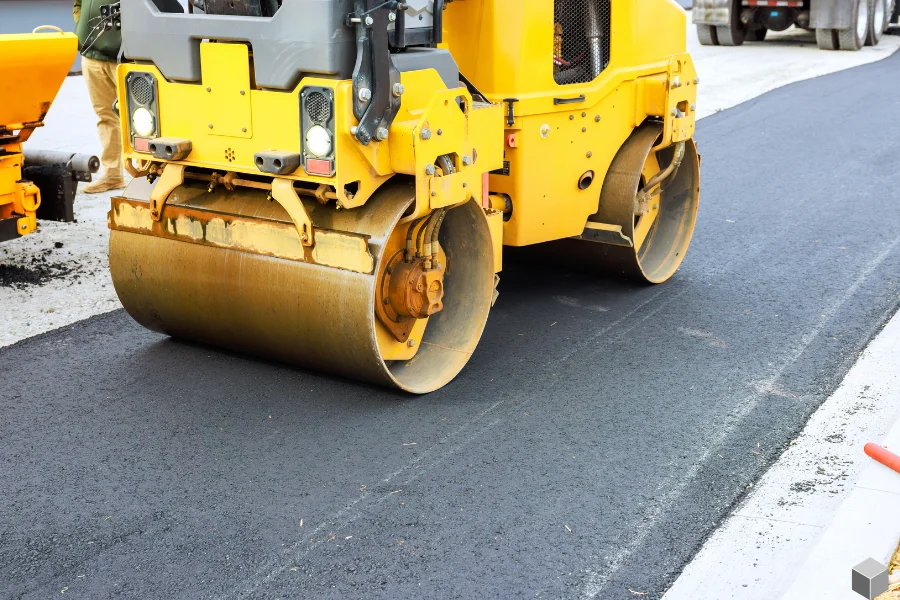
1. Mechanical compaction (immediate): Proper rolling with a plate compactor or drum roller immediately locks the particles together. This provides the initial stability that allows the surface to be used right away for light traffic.
2. Solar activation of residual binder (weeks to months): The residual bitumen binder left in the millings softens under heat from the sun and re-bonds the particles together more firmly over time. This is what gives millings their characteristic asphalt-like hardness.
Hardening Timeline
| Timeframe | What to Expect |
|---|---|
| Immediately after compaction | Surface is firm and trafficable for light vehicles |
| 1–2 weeks | Initial binding begins; millings start to feel less loose at surface |
| 1–3 months (summer) | Significant hardening; surface develops asphalt-like quality |
| 3–12 months | Continued hardening as binder fully re-activates through heat cycles |
| 1–2 years (full cure) | Maximum hardness; surface comparable to aged asphalt in performance |
Factors That Speed Up or Slow Down Hardening
- Sun exposure: More direct sunlight = faster binder activation. Shaded driveways take significantly longer.
- Temperature: Warm climates harden millings faster. Cold climates slow the process considerably.
- Initial compaction quality: Better compaction at installation means faster overall hardening.
- Traffic: Regular vehicle traffic actually helps by applying heat and pressure through the surface.
- Millings quality: Higher binder content millings (from more recently milled, older pavement) harden faster.
Practical advice: Plan your millings installation in spring if possible so the surface gets a full summer season of heat exposure. Avoid laying millings in late fall in cold climates — the material won’t harden significantly until the following spring.
Compaction: The Most Important Step
No matter how accurately you calculate your asphalt millings quantity, the entire project depends on proper compaction. Millings that aren’t adequately compacted will shift, rut, and wash out — regardless of how deep you install them.
Compaction Equipment Options
| Equipment | Best For | Typical Rental Cost |
|---|---|---|
| Plate compactor | Paths, edges, small areas | $80–$150/day |
| Single-drum vibratory roller | Standard driveways, parking pads | $200–$400/day |
| Double-drum roller | Larger driveways, commercial areas | $300–$600/day |
| Pneumatic roller | Finishing surface after drum rolling | $300–$500/day |
| Truck passes (tire compaction) | Emergency compaction, rural lanes | Minimal cost |
How to Compact Millings Correctly
- Make at least 3–5 complete passes over the entire surface with your roller
- Overlap each pass by 6 inches to ensure full coverage
- Compact while the material is slightly warm or in direct sunlight — never in cold, wet conditions
- For depths over 4 inches, compact in two separate lifts (layers) rather than one pass
- Slightly dampen dry millings with water before compacting if they’re very dry — this helps initial binding
- Roll the perimeter edges first, then work inward in overlapping passes
A well-compacted surface of millings feels firm underfoot and leaves no footprints. If you can push your foot into the surface, it needs more compaction.
Asphalt Millings vs. Gravel vs. Fresh Asphalt
Understanding where millings fit in the material landscape helps you make the right choice for your project.
Material Comparison
| Factor | Asphalt Millings | Crushed Gravel | Hot-Mix Asphalt |
|---|---|---|---|
| Material cost | $8–$40/ton | $15–$45/ton | $80–$200/ton |
| Installed cost (driveway) | $1–$3/sq ft | $1–$3/sq ft | $3–$8/sq ft |
| Durability | Good (hardens over time) | Moderate (stays loose) | Excellent |
| Maintenance | Low | Moderate (respreading) | Low to moderate |
| Appearance | Dark, asphalt-like | Light, gravel look | Smooth, black |
| Dust control | Good once hardened | Poor (dust and mud) | Excellent |
| Drainage | Good | Excellent | Moderate |
| DIY-friendly | Very good | Very good | Difficult |
| Environmental | Excellent (recycled) | Good | Moderate |
Best choice summary:
- Choose millings when you want an affordable, low-maintenance surface that will harden and look like asphalt
- Choose gravel when drainage is the top priority and appearance is less important
- Choose hot-mix asphalt for maximum durability, curb appeal, and a truly permanent surface
Tips for Getting the Most Accurate Millings Estimate
Measure Irregular Areas Correctly
Most driveways and lanes aren’t perfect rectangles. For irregular shapes, break the area into separate sections (rectangles, triangles), calculate each individually, and add the totals.
Account for Crown and Slope
Driveways with a crowned center (slightly raised in the middle for drainage) or a significant slope use more material at the edges and transitions. Add 5–8% extra for sloped or crowned surfaces beyond the standard 10% waste factor.
Order by the Ton, Not by Volume
Asphalt millings are always priced and sold by weight (tons). The conversion from cubic yards to tons varies with moisture content. If you’ve calculated cubic yards, multiply by 1.5–1.6 to get tons for ordering.
Ask Your Supplier About Gradation
Not all millings are equal. Coarse millings with larger chunks compact less predictably. Fine, well-processed millings compact more evenly and produce a better finished surface. Ask your supplier whether their millings are screened, and what the maximum particle size is.
Source Millings from Local Road Projects
The cheapest millings come directly from road milling contractors who need to dispose of material quickly. Check with your local county highway department or road construction companies — sometimes millings are available free or at very low cost for self-haul projects.
Frequently Asked Questions
How Do I Calculate How Much Asphalt Millings I Need?
Measure the length and width of your project area in feet, multiply them together to get square footage, then multiply by your desired depth in feet (depth in inches ÷ 12). Divide by 27 to convert cubic feet to cubic yards, then multiply by 1.55 to convert to tons. Add 10% for compaction and waste. The formula is: Tons = (Length × Width × Depth in inches) ÷ 324 × 1.55 × 1.10.
Example for a 50 ft × 12 ft driveway at 4 inches deep: (50 × 12 × 4) ÷ 324 × 1.55 × 1.10 = *12.6 tons.
How Much Will 1 Ton of Asphalt Millings Cover?
At 2 inches compacted depth, 1 ton of asphalt millings covers approximately 80–90 square feet. At 3 inches, it covers about 55–60 square feet. At 4 inches, approximately 40–45 square feet. The exact coverage depends on the compacted density of the specific millings, but these figures are reliable planning benchmarks. Use the coverage tables earlier in this article for quick reference across multiple depths.
How Much Does 1 Yard of Asphalt Milling Weigh?
One cubic yard of loose, dry asphalt millings weighs approximately 2,970 to 3,240 pounds (about 1.49 to 1.62 tons). Once compacted in place, the same volume weighs 3,645 to 3,996 pounds (1.82 to 2.0 tons). For ordering purposes, use 1.5 to 1.6 tons per cubic yard, as suppliers weigh and sell millings in their loose delivered state.
How Many Inches of Asphalt Millings Do I Need?
For a standard residential driveway with passenger car traffic, 3–4 inches of compacted millings is the recommended minimum. For driveways that regularly carry trucks, RVs, or heavy equipment, use 4–6 inches and install in two compacted lifts. For foot traffic paths and light-use areas, 2 inches may be sufficient on a stable base. Always increase depth if your soil is soft, clay-heavy, or prone to frost heave.
Do I Need Gravel Under Asphalt Millings?
Not always, but often yes. If your soil is sandy, well-drained, and already compacted, you may be able to apply millings directly. However, if your soil is clay-heavy, poorly drained, or subject to freeze-thaw cycles, a 4–6 inch compacted crushed stone base is strongly recommended beneath the millings. Without a proper base, heavy loads will cause ruts, soft spots, and premature surface failure regardless of how thick your millings layer is.
How Long Does It Take Millings to Harden?
A freshly compacted millings surface is trafficable for light vehicles immediately. Initial binding begins within 1–2 weeks. Significant hardening — where the surface develops a true asphalt-like quality — typically takes 1–3 months during warm summer conditions. Full hardening can take 1–2 years of heat cycles as the residual bitumen binder fully re-activates. Surfaces in full sun harden faster than shaded ones. In cold climates, minimal hardening occurs over winter; the process resumes in spring.
Summary: Asphalt Millings Calculator Quick Reference
| Calculation | Formula / Value |
|---|---|
| Volume (cubic feet) | Length × Width × Depth (ft) |
| Cubic yards | Cubic feet ÷ 27 |
| Tons from cubic yards | Cubic yards × 1.55 (loose density) |
| Tons from sq ft + inches | (Sq ft × depth in inches) ÷ 324 × 1.55 |
| Coverage per ton at 2″ | ~80–90 sq ft |
| Coverage per ton at 4″ | ~40–45 sq ft |
| Loose weight per cubic yard | ~2,970 – 3,240 lbs |
| Compacted weight per cubic yard | ~3,645 – 4,000 lbs |
| Waste/compaction overage | Add 10–15% |
| Typical hardening time | 1–3 months (summer conditions) |
Use the asphalt milling calculator at the top of this page to get your tonnage and cubic yard estimate instantly — enter your dimensions and depth, and the calculator handles the density conversion, compaction factor, and final order quantity automatically.