
Sod Calculator
Sod Calculator: How Much Sod Do You Need?
Whether you’re replacing a patchy lawn, starting fresh, or filling in bare spots, the first question is always the same: how much sod do I need? Buy too little and you’re scrambling for a matching pallet from a different cutting — and fresh sod waits for no one. Buy too much and you’re paying for material that goes to waste within 48 hours. This guide explains the sod calculation formula, covers rolls vs. slabs vs. pallets, and walks through cost for every major grass type.
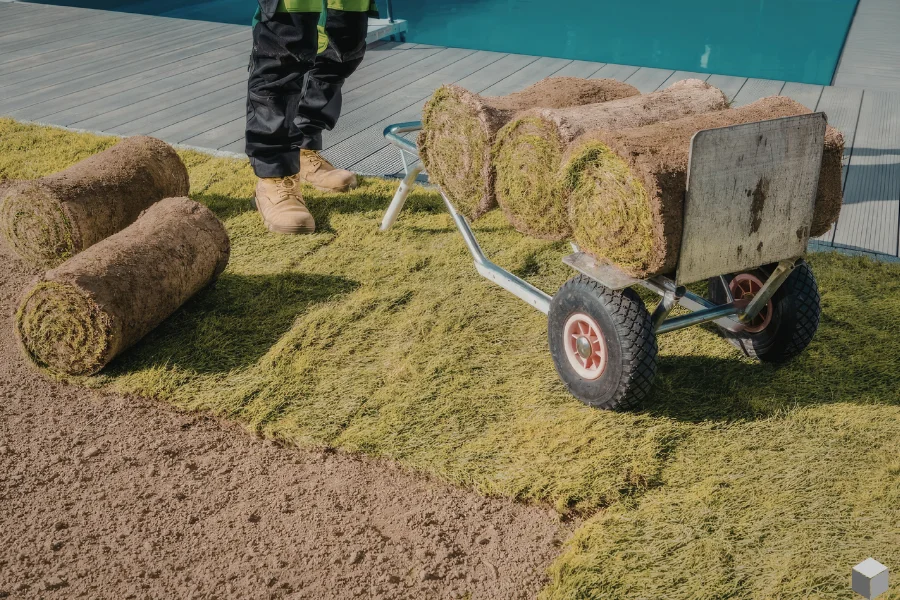
How to Calculate How Much Sod You Need
The Sod Calculation Formula
Step 1 — Measure your lawn area
For a rectangular lawn:
Area = Length (ft) × Width (ft)
For irregularly shaped lawns, break the space into smaller rectangular sections, calculate the area of each one, and add them together.
Step 2 — Add a waste factor
Sod always gets trimmed around edges, curves, and obstacles. Add 5–10% to your total area to account for cuts and waste.
Total Sod Needed = Area × 1.05 to 1.10
Step 3 — Convert to rolls, slabs, or pallets
Once you have your total square footage, divide by the coverage per unit to get your order quantity.
Sod Calculation Example
Lawn: 50 ft × 40 ft = 2,000 sq ft. Add 10% waste:
2,000 × 1.10 = 2,200 sq ft needed
At 450 sq ft per pallet: 2,200 ÷ 450 = 4.9 → order 5 pallets
Our sod calculator runs this automatically — enter your lawn dimensions, select your unit type (rolls, slabs, or pallets), and get your order quantity instantly.
Sod Sizes: Rolls, Slabs, and Pallets
Sod is sold in rolls, slabs, and pallets. Focus on the square-foot coverage rather than the number of rolls or pallets when ordering, as size and coverage can vary significantly between suppliers.
| Unit | Typical Size | Coverage |
|---|---|---|
| Small slab / piece | 16″ × 24″ | ~2.7 sq ft |
| Standard roll | 2 ft × 5 ft | 10 sq ft |
| Large roll | 2 ft × 8 ft | 16 sq ft |
| Half pallet | — | 200–250 sq ft |
| Full pallet | — | 400–500 sq ft |
Most suppliers in the US use 450 sq ft as the standard full pallet. Some use 400 sq ft; verify with your local supplier before ordering.
How Much Sod for Common Lawn Sizes
| Lawn Size | Sq Ft | Pallets Needed (450 sq ft) | Pallets With 10% Waste |
|---|---|---|---|
| Small yard | 500 sq ft | 1.1 pallets | 1.2 → 2 pallets |
| 200 sq ft patch | 200 sq ft | 0.44 pallets | 0.49 → order by roll |
| Average front yard | 1,000 sq ft | 2.2 pallets | 2.4 → 3 pallets |
| Average back yard | 2,000 sq ft | 4.4 pallets | 4.9 → 5 pallets |
| Large residential | 5,000 sq ft | 11.1 pallets | 12.2 → 13 pallets |
| Small acre | 10,000 sq ft | 22.2 pallets | 24.4 → 25 pallets |
| Full acre | 43,560 sq ft | 96.8 pallets | 106 → 107 pallets |
Sod Cost Per Square Foot by Grass Type (2025–2026)
Sod costs $0.30 to $0.80 per square foot for materials only, or $1 to $2 per square foot when including soil preparation, delivery, and installation fees. A pallet of sod costs $130 to $360 for bulk wholesale or up to $450 per pallet retail, covering approximately 450 square feet.
| Grass Type | Cost Per Sq Ft | Cost Per Pallet | Best For |
|---|---|---|---|
| Bermuda | $0.40 – $0.85 | $180 – $380 | Full sun, drought tolerance, high traffic |
| St. Augustine | $0.45 – $0.90 | $200 – $405 | Shade tolerance, warm humid climates |
| Zoysia | $0.70 – $1.30 | $315 – $585 | Sun/partial shade, dense growth, low mow |
| Centipede | $0.30 – $0.60 | $135 – $270 | Low maintenance, acidic soils, South US |
| Kentucky Bluegrass | $0.35 – $0.75 | $158 – $338 | Cool climates, fine texture |
| Fescue | $0.30 – $0.65 | $135 – $293 | Shade, cool season, North/Transition Zone |
| Bahia | $0.25 – $0.55 | $113 – $248 | Low maintenance, sandy soils, Florida |
St. Augustine Sod Calculator
St. Augustine sod costs $0.45 to $0.90 per square foot or $200 to $405 per pallet, not including installation. It’s a dense, coarse-bladed grass that thrives in warm climates, tolerates partial shade, and is known for its robust growth and excellent salt tolerance. Popular varieties include Floratam, Raleigh, and Palmetto. Unlike Bermuda, St. Augustine cannot be grown from seed — sod or plugs are the only options.
Total Sod Installation Cost
Materials are just the beginning. Here’s a complete cost breakdown for a professional sod installation:
| Cost Component | Typical Range |
|---|---|
| Sod materials | $0.30 – $1.30 per sq ft |
| Delivery | $50 – $200 per load |
| Soil preparation / grading | $0.25 – $0.50 per sq ft |
| Old lawn removal | $0.50 – $2.00 per sq ft |
| Professional installation labor | $0.50 – $1.50 per sq ft |
| Soil testing | $10 – $50 |
| Total installed (materials + labor) | $1.00 – $2.40 per sq ft |
Professional sod installation adds $1.00 to $2.00 per square foot to the cost of buying the sod and having it delivered. Typical homeowners spend between $3,000 and $7,500 for a complete residential sod installation.
Is It Cheaper to Lay Sod Yourself?
Yes — significantly. DIY sod installation eliminates the $0.50–$1.50/sq ft labor cost. For a 2,000 sq ft yard with St. Augustine sod at $0.65/sq ft:
- DIY total: ~$1,430 (sod + delivery + basic tools)
- Professional total: ~$2,600–$4,000 (same materials + labor + site prep)
The trade-off is physical effort and the learning curve. Sod installation is genuinely hard work — cutting, hauling, and precisely fitting hundreds of pieces in a single day before the sod dries out. For lawns over 3,000 sq ft, most DIYers find professional installation worth the cost difference.
Sod Weight: How Heavy Is a Roll or Pallet?
A standard 2 ft × 5 ft roll of sod covers 10 square feet and typically weighs 25 to 50 pounds when freshly cut, depending on grass type, moisture content, and soil thickness.
A full 450 sq ft pallet weighs approximately 1,500–2,500 lbs, which is why a standard pickup truck can typically carry half a pallet at most. Always verify weight limits before transporting sod in a personal vehicle.
| Unit | Coverage | Weight |
|---|---|---|
| 2×5 ft roll (10 sq ft) | 10 sq ft | 25–50 lbs |
| Slab / piece (~2.7 sq ft) | 2.7 sq ft | 7–15 lbs |
| Half pallet (225 sq ft) | 225 sq ft | 750–1,250 lbs |
| Full pallet (450 sq ft) | 450 sq ft | 1,500–2,500 lbs |
When to Lay Sod: Timing by Grass Type
Getting the timing right dramatically affects how quickly sod establishes and how much watering it needs.
| Grass Type | Best Season to Lay | Avoid |
|---|---|---|
| Bermuda | Late spring – early summer | Winter (dormant) |
| St. Augustine | Spring – early summer | Winter, drought |
| Zoysia | Spring – early summer | Fall / Winter |
| Kentucky Bluegrass | Early fall or spring | Summer heat |
| Fescue | Early fall | Summer |
| Centipede | Late spring | Fall / Winter |
The best time to lay sod is early spring or fall when temperatures are cooler. Sod can be installed any time the ground isn’t frozen and temperatures are below 90°F. Warm-season grasses like Bermuda, St. Augustine, and Zoysia are best laid in spring since they’re dormant in winter.
Tips for Buying and Laying Sod
Order the same day it’s cut. A pallet of sod lasts about 48 hours in summer and up to 72 hours in colder temperatures. If sod must be stored before installation, lay the pieces out in a shaded location and water lightly.
Prepare the soil before delivery. Till to 2–4 inches, remove debris, grade for drainage, and apply starter fertilizer. Laying sod on compacted or weedy soil is the top reason for failed establishment.
Lay in staggered rows. Like brick coursing — offset each row by half a slab length so joints don’t align. This reduces visible seam lines and improves rooting.
Water within 30 minutes of laying. New sod needs 1–1.5 inches of water immediately after installation, then daily watering for the first two weeks. Roots establish in 10–14 days under proper conditions.
Don’t mow for the first 2–3 weeks. Let the root system anchor before adding mowing stress. When you do mow, don’t remove more than 1/3 of the blade height.
Frequently Asked Questions
How Do You Calculate How Much Sod You Need?
Measure your lawn’s length and width in feet and multiply for total square footage. Add 5–10% for waste from edge cuts and trimming. Divide the adjusted total by the coverage per unit (typically 450 sq ft per pallet, 10 sq ft per roll) to get your order quantity. Our sod calculator does this instantly.
Is October Too Late to Lay Sod?
For warm-season grasses (Bermuda, St. Augustine, Zoysia), October is generally too late in most regions — these grasses go dormant in cooler temperatures and won’t establish before frost. For cool-season grasses (fescue, Kentucky bluegrass), early October is actually ideal in most of the US. In Florida and the Gulf Coast, October is still viable for warm-season varieties because frost is rare.
How to Calculate Sod Requirements?
Total Area × 1.10 (10% waste) ÷ Coverage Per Unit = Units Needed. For a 1,500 sq ft lawn: 1,500 × 1.10 = 1,650 sq ft ÷ 450 = 3.67 → order 4 pallets. For small patches, calculate in rolls: 200 sq ft ÷ 10 sq ft/roll = 20 rolls needed.
How Many Sq Ft Per Piece of Sod?
A standard slab measures approximately 16″ × 24″ = 2.67 square feet. Rolls are typically 2 ft × 5 ft = 10 square feet. Some suppliers cut larger rolls at 2 ft × 8 ft = 16 square feet. Always confirm the exact size with your supplier, as dimensions vary.
How Much Does a 2 ft by 5 ft Roll of Sod Weigh?
A 2×5 ft roll covering 10 square feet typically weighs 25–50 lbs when freshly cut, depending on grass type, soil depth, and moisture. Heavier soils and wetter cuts can push a roll toward 50 lbs. Plan accordingly for carrying and transporting multiple rolls.
Is It Cheaper to Lay Sod Yourself?
Yes. DIY sod installation typically saves $0.50–$1.50 per square foot in labor costs. On a 2,000 sq ft lawn, that’s a savings of $1,000–$3,000. The sod materials cost the same either way. DIY makes the most financial sense for smaller lawns, flat terrain, and homeowners comfortable with physical outdoor work. For large yards, sloped terrain, or complex shaping, professional installation often pays for itself through faster establishment and fewer mistakes.