
Gravel Calculator
Gravel Calculator: How to Calculate How Much Gravel You Need
Whether you’re building a driveway, laying a patio base, filling a French drain, or spreading decorative rock across a garden bed, the most important number you need before placing any order is: how many tons of gravel do I actually need? Ordering too little means a second delivery. Ordering too much means paying for material that sits unused.
This guide gives you the formula, coverage tables, density values, driveway tonnage estimates, cost breakdowns, and everything else you need to estimate gravel for any project.
The Gravel Calculator Formula
Calculating how much gravel you need follows the same volume formula as any aggregate material. All measurements must be in feet before you calculate.
Step 1 — Calculate Volume in Cubic Feet Length (ft) × Width (ft) × Depth (ft) = Cubic Feet
Step 2 — Convert to Cubic Yards Cubic Feet ÷ 27 = Cubic Yards
Step 3 — Convert to Tons Cubic Yards × Density (tons/yd³) = Tons
Step 4 — Add Overage Tons × 1.10 = Final Order Quantity (10% waste standard)
Quick Shortcut
If you know your area in square feet and depth in inches:
(Square Feet × Depth in Inches) ÷ 324 = Cubic Yards
Then multiply by 1.4–1.5 (standard gravel density) to get tons.
Example: A 12 ft × 100 ft driveway at 4 inches deep: (1,200 × 4) ÷ 324 = 14.8 cubic yards × 1.4 = 20.7 tons + 10% = order 23 tons
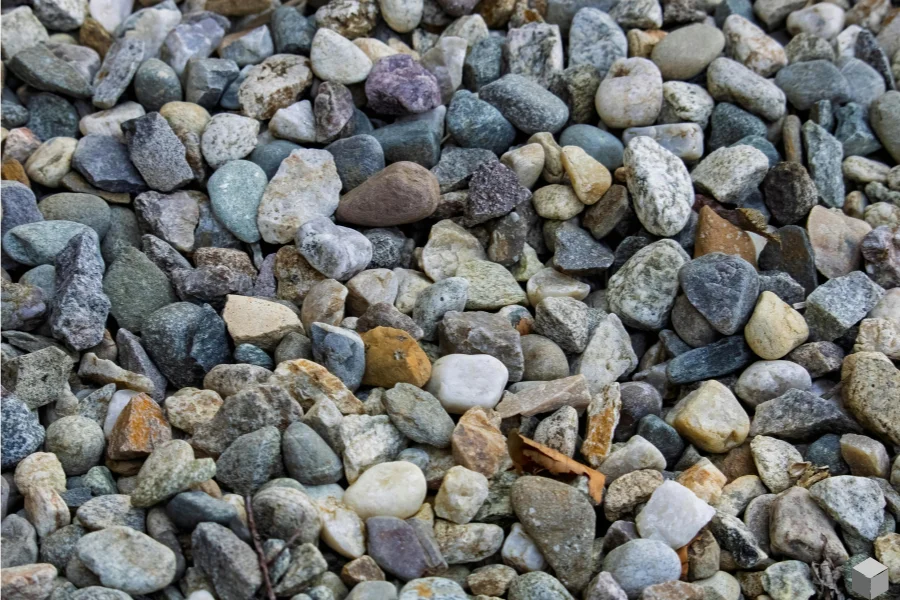
Gravel Density: Tons per Cubic Yard
The key variable that converts volume to weight is the density of your specific gravel type. Suppliers sell and price by the ton, so getting this right prevents costly underestimates.
Gravel and Aggregate Density Reference
| Material | Lbs per Cubic Yard | Tons per Cubic Yard |
|---|---|---|
| Pea gravel (1/4″ – 1/2″) | 2,400 – 2,800 lbs | 1.2 – 1.4 tons |
| Regular gravel (1/4″ – 2″) | 2,800 – 3,400 lbs | 1.4 – 1.7 tons |
| Crushed stone / #57 | 2,700 – 3,200 lbs | 1.35 – 1.6 tons |
| Crusher run / crush and run | 3,300 – 3,800 lbs | 1.65 – 1.9 tons |
| River rock (2″ – 6″) | 3,000 – 3,400 lbs | 1.5 – 1.7 tons |
| Decomposed granite | 2,400 – 2,800 lbs | 1.2 – 1.4 tons |
| Road base / class 5 | 3,200 – 3,600 lbs | 1.6 – 1.8 tons |
| Crushed concrete | 2,500 – 3,000 lbs | 1.25 – 1.5 tons |
| Crushed limestone | 2,700 – 3,200 lbs | 1.35 – 1.6 tons |
For general estimating: use 1.5 tons per cubic yard as a safe all-purpose planning figure for most standard gravel types.
How Much Will 1 Ton of Gravel Cover?
Coverage per ton depends entirely on the depth you’re spreading the material. Using a standard gravel density of approximately 1.4 tons per cubic yard:
Coverage per Ton by Depth
| Depth | Square Feet per Ton (approx.) |
|---|---|
| 1 inch | 240 sq ft |
| 2 inches | 120 sq ft |
| 3 inches | 80 sq ft |
| 4 inches | 60 sq ft |
| 6 inches | 40 sq ft |
One ton of gravel at 2 inches deep covers approximately 120 square feet — about a 10 × 12 ft area. At the standard driveway depth of 4 inches, one ton covers roughly 60 square feet.
Coverage per Cubic Yard by Depth
| Depth | Square Feet per Cubic Yard |
|---|---|
| 1 inch | 324 sq ft |
| 2 inches | 162 sq ft |
| 3 inches | 108 sq ft |
| 4 inches | 81 sq ft |
| 6 inches | 54 sq ft |
Tons to Yards: Quick Conversion Reference
Most gravel suppliers sell by the ton. If you’ve calculated cubic yards, use this to convert.
| Cubic Yards | Approximate Tons (at 1.5 tons/yd³) |
|---|---|
| 1 cubic yard | 1.4 – 1.7 tons |
| 2 cubic yards | 2.8 – 3.4 tons |
| 5 cubic yards | 7.0 – 8.5 tons |
| 10 cubic yards | 14.0 – 17.0 tons |
Conversely, 1 ton of gravel = approximately 0.59–0.71 cubic yards. To convert tons to yards: divide by 1.4 (for light gravel) or 1.7 (for dense gravel).
Gravel Types and Their Best Applications
Not all gravel is suited to every job. Using the wrong type leads to drainage failures, unstable surfaces, or wasted material.
Gravel Type and Application Guide
| Gravel Type | Size | Best Uses |
|---|---|---|
| Pea gravel | 3/8″ – 1/2″ | Walkways, playgrounds, decorative beds, drainage |
| #57 stone | 3/4″ – 1″ | Driveways, drainage, pipe bedding, concrete mix |
| Crusher run (crush and run) | 0 – 3/4″ mixed | Driveway base, road base, sub-base compaction |
| River rock | 2″ – 6″ | Decorative landscaping, stream beds, erosion control |
| 3/4″ crushed stone | 3/4″ | Driveways, French drains, under slabs |
| Decomposed granite | Fine, 1/4″ | Pathways, patios, landscape accents |
| Road base / class 5 | Mixed | Driveway base, parking areas, rural roads |
| Crushed limestone | Various | Driveways, base layers, agricultural use |
| Drain rock / 57 clean stone | 1/2″ – 1.5″ | French drains, septic fields, drainage trenches |
| Paver base | Fine graded | Under pavers, patios, walkway bases |
| ABC stone / ca6 | 0 – 2″ mixed | Road base, parking lots, base compaction |
| Crushed concrete | Recycled | Budget base material, fill, road base |
Gravel Driveway Calculator: Tons by Dimension
Driveways are the most common large gravel project. Standard depth is 4 inches for light vehicle traffic; 6 inches for heavy or frequent use.
Driveway Gravel Needed by Size
| Driveway Dimensions | 4 Inches Deep | 6 Inches Deep |
|---|---|---|
| 10 × 50 ft (500 sq ft) | 7.7 tons | 11.6 tons |
| 10 × 100 ft (1,000 sq ft) | 15.4 tons | 23.1 tons |
| 12 × 100 ft (1,200 sq ft) | 18.5 tons | 27.8 tons |
| 14 × 100 ft (1,400 sq ft) | 21.6 tons | 32.4 tons |
| 12 × 200 ft (2,400 sq ft) | 37.0 tons | 55.6 tons |
| 16 × 200 ft (3,200 sq ft) | 49.4 tons | 74.1 tons |
These figures use a density of 1.4 tons/yd³ and include a 10% waste factor. For crusher run (denser at 1.7–1.9 tons/yd³), multiply these figures by 1.2.
How Many Tons of Gravel for 1,000 Square Feet?
At 4 inches deep using standard gravel: approximately 15–17 tons depending on the specific material. Use crusher run for a compacted driveway base — at 4 inches you’ll need closer to 18–20 tons per 1,000 sq ft due to higher density.
Recommended Depth by Application
Gravel Depth Guide
| Application | Recommended Depth | Stone Type |
|---|---|---|
| Residential driveway (cars) | 4 inches | Crusher run or #57 |
| Driveway with truck traffic | 6 inches | Crusher run base |
| Garden path / walkway | 2–3 inches | Pea gravel or DG |
| Patio base under pavers | 4–6 inches | Compacted class 5 or #57 |
| French drain trench | Fill to grade | 3/4 clean stone or #57 |
| Lawn drainage layer | 3–4 inches | Drain rock |
| Landscape decorative bed | 2–3 inches | River rock or pea gravel |
| Under concrete slab | 4 inches | #57 or compacted road base |
| Shed or outbuilding base | 4–6 inches | Crusher run or class 5 |
| Aquarium gravel | 1–2 inches | Fine pea gravel, washed |
How Much Is 1 Truckload of Gravel?
Gravel delivery comes in various truck sizes, each carrying different volumes and weights.
Truck Load Capacity and Cost
| Truck Type | Typical Capacity | Approximate Material Cost |
|---|---|---|
| Standard pickup truck | 0.5 – 1 cubic yard (½ – 1 ton) | $20 – $70 |
| Small dump truck | 5 – 8 tons | $150 – $400 |
| Standard dump truck | 10 – 14 tons | $300 – $700 |
| Full tandem dump truck | 14 – 25 tons | $450 – $1,250 |
Material cost for gravel runs approximately $25–$50 per ton delivered (standard crushed stone or pea gravel). Specialty stone, river rock, and decomposed granite run higher at $40–$80 per ton delivered. Always confirm with local suppliers — transportation distance is the biggest pricing variable.
How Much Is 1,000 Square Feet of Gravel?
For a 1,000 sq ft area at 3 inches deep using standard pea gravel or crushed stone:
- Volume: (1,000 × 3) ÷ 324 = 9.26 cubic yards
- Tons: 9.26 × 1.4 = 12.96 tons
- Add 10%: 14.3 tons
- Material cost at $35/ton: approximately $500
- Delivered and installed: $750 – $1,500 depending on region and labor
At 2 inches deep (decorative landscape application): approximately 8–9 tons, around $280–$450 in materials.
What Is the Cheapest Way to Buy Gravel?
Gravel price per ton drops significantly as your order volume increases and as you reduce transportation steps.
1. Self-haul from a quarry or landscape supplier. Picking up gravel yourself eliminates delivery charges. Bring a pickup truck or rent a trailer. Most quarries sell by the ton at a scale — you drive in, load, weigh out.
2. Order in full truck loads. Suppliers charge short-load fees for partial deliveries. Ordering a complete dump truck load (typically 10–14 tons) eliminates these fees and often gets you a lower per-ton price.
3. Buy recycled or crushed concrete. Recycled crushed concrete is the least expensive base material available in most markets, running $6–$14 per ton compared to $15–$25 for virgin limestone crusher run.
4. Shop in late fall or winter. Demand for gravel and landscaping materials drops significantly after summer. Prices often fall 10–20% from peak-season levels.
5. Compare bulk pricing vs. bagged. Bags of pea gravel from a home improvement store cost $4–$6 for 0.5 cubic feet — equivalent to $1,000–$1,500 per cubic yard. Bulk delivery of the same material runs $25–$50 per yard. For any project over 1 cubic yard, bulk is almost always dramatically cheaper.
Is 2 Inches of Gravel Enough for a Driveway?
No — 2 inches of gravel is not enough for a functional driveway that carries vehicles. Here’s why:
- At 2 inches, gravel does not have enough depth to distribute vehicle loads. Under tire pressure, the gravel compresses into the subgrade, creating ruts and soft spots within weeks.
- The standard minimum for a residential driveway is 4 inches of compacted gravel on a well-prepared subgrade.
- For driveways that carry trucks, RVs, or heavy equipment regularly, 6 inches is the recommended depth.
- For driveways in climates with significant freeze-thaw cycles, many contractors recommend 6–8 inches to prevent frost heave from pushing through the gravel layer.
The right approach:
- Use crusher run or dense-grade aggregate for the base layer — its fine particles compact to a solid, stable surface
- If your budget allows, top the compacted crusher run with 1–2 inches of 3/4 clean stone or pea gravel for a finished appearance
- Always compact the base layer with a plate compactor or roller before adding any top layer
Compaction: What You Need to Factor In
If you’re filling an area that will be compacted — a driveway, road base, or sub-base under concrete — you need to account for volume loss during compaction. Gravel can lose 20–30% of its loose volume when compacted.
Practical guideline: For any project involving compacted base material (crusher run, road base, class 5), increase your calculated tonnage by 15–25% beyond the standard 10% waste factor. So if your calculation says 20 tons, order 23–25 tons to end up with the right compacted depth.
Frequently Asked Questions
How Much Will 1 Ton of Gravel Cover?
One ton of standard gravel (1/4″ to 2″) covers approximately 120 square feet at 2 inches deep, 80 square feet at 3 inches, and 60 square feet at 4 inches deep. Exact coverage varies with particle size — smaller, smoother gravel packs tighter and covers slightly less area per ton than coarser stone at the same depth.
How Do I Calculate How Much Gravel I Need?
Multiply your area’s length × width in feet to get square footage. Multiply by your desired depth in feet (depth in inches ÷ 12). Divide by 27 to convert cubic feet to cubic yards. Multiply by 1.4–1.5 to get tons. Add 10% for waste. The shortcut: (square feet × depth in inches) ÷ 324 = cubic yards, then × 1.5 = tons.
How Much Is 1 Truckload of Gravel?
A standard dump truck carries 10–14 tons of gravel. At typical delivered pricing of $30–$50 per ton, a full truckload costs approximately $300–$700 in material. Premium stone types like river rock or decomposed granite run $400–$1,200 per truckload. Delivery charges vary by distance and supplier — always request a delivered price rather than just a per-ton rate.
How Much Is 1,000 Square Feet of Gravel?
A 1,000 sq ft area at 3 inches deep requires approximately 13–15 tons of standard gravel. At current market rates of $30–$50 per ton delivered, that’s roughly $390–$750 in material. Installed costs with labor and grading typically run $800–$1,500 for a 1,000 sq ft area depending on site conditions and region.
What Is the Cheapest Way to Buy Gravel?
Self-hauling from a quarry or landscape supplier eliminates delivery costs and is the cheapest option for small quantities. For larger projects, ordering a full dump truck load (10–14 tons) eliminates short-load fees and reduces per-ton price. Recycled crushed concrete is the least expensive base material at $6–$14 per ton at the quarry. Buying in the off-season (late fall through early spring) typically saves 10–20% compared to peak-season pricing.
Is 2 Inches of Gravel Enough for a Driveway?
No. Two inches of gravel is insufficient for any driveway that carries vehicles. The minimum depth for a residential gravel driveway is 4 inches of compacted material. At 2 inches, vehicle loads compress the gravel into the subgrade quickly, creating ruts and soft spots. For driveways carrying trucks, RVs, or frequent vehicle traffic, 6 inches is the recommended standard. Always compact gravel in layers rather than dumping the full depth at once.
Quick Reference Summary
| Calculation | Formula / Value |
|---|---|
| Cubic yards from dimensions | (L × W × D in ft) ÷ 27 |
| Cubic yards from sq ft + inches | (Sq ft × depth in inches) ÷ 324 |
| Tons from cubic yards | Cubic yards × 1.4–1.7 (standard gravel) |
| Standard density estimate | 1.5 tons per cubic yard |
| Coverage at 2″ (per ton) | ~120 sq ft |
| Coverage at 4″ (per ton) | ~60 sq ft |
| 1,000 sq ft at 4″ | ~15–17 tons |
| Driveway minimum depth | 4 inches compacted |
| Compaction factor | Add 15–25% for compacted base |
| Waste factor (all projects) | Add 10% minimum |
Use the gravel calculator above to get your cubic yards and tonnage instantly — enter your length, width, and depth, select your gravel type, and the calculator handles the density conversion, waste factor, and material cost in one step.